Taller structures produce more blaze-spreading embers, OSU research suggests
Story By
Steve Lundeberg, 541-737-4039
[email protected]
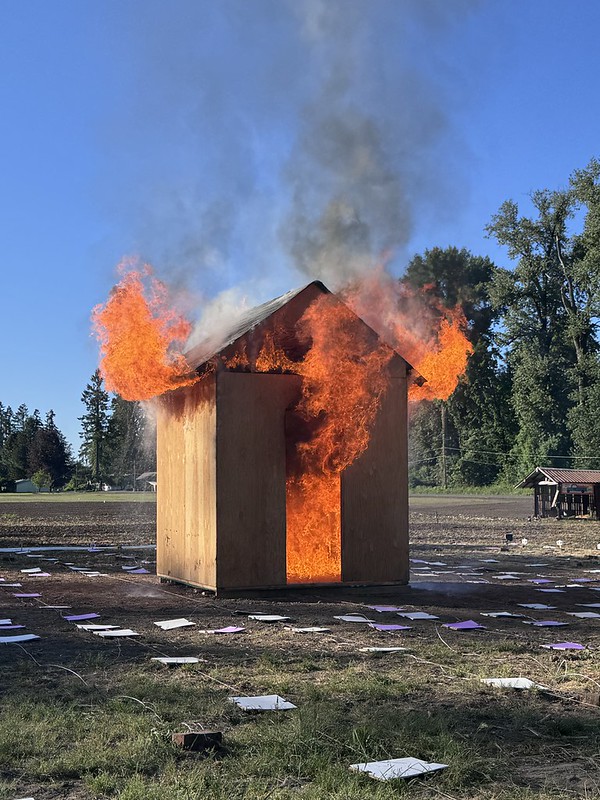
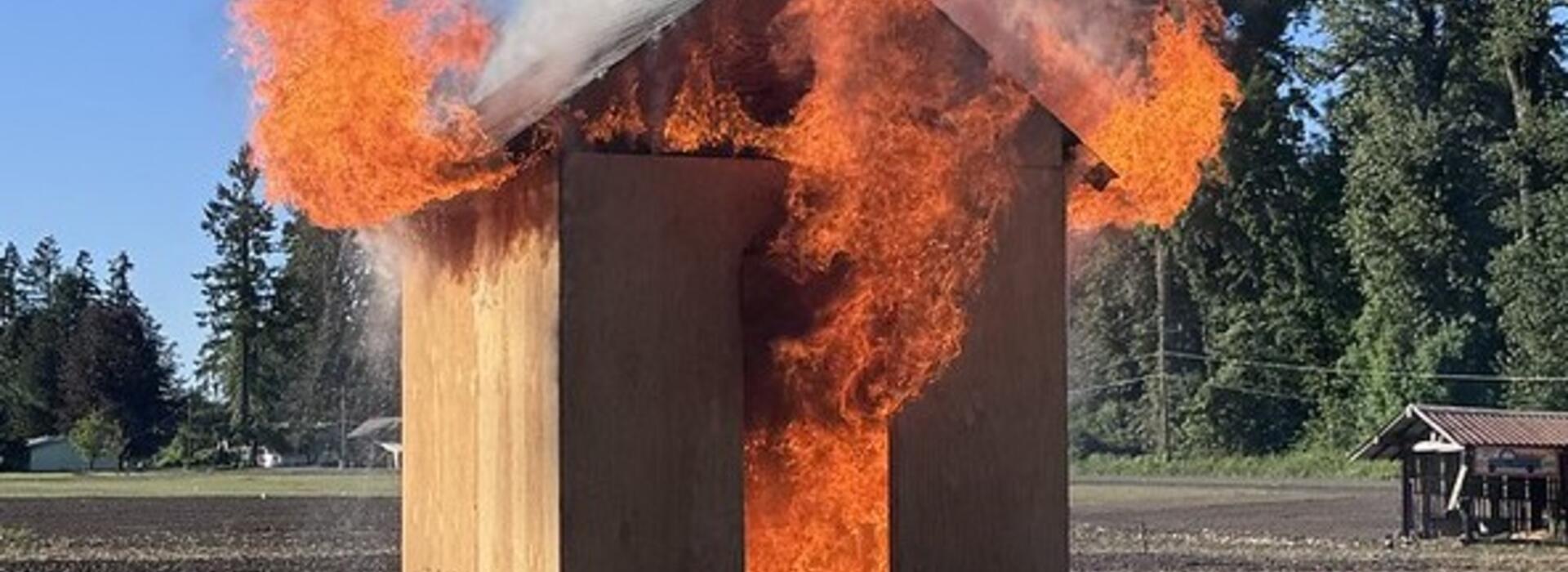
CORVALLIS, Ore. – Test burns involving wooden structures of varying heights suggest taller buildings tend to be more prolific producers of the wind-carried firebrands that are a leading cause of structure ignition in wildfires.
The findings by Oregon State University College of Engineering researchers are a step toward better predicting how fires in the wildland-urban interface will spread and also toward designing buildings that can help communities be more resilient to wildfire, the authors say.
Firebrands, also known as embers, can be responsible for up to 90% of the structure losses in community wildfires, the researchers note. Last year, wildfires in greater Los Angeles destroyed approximately 18,000 structures in a span of two days.
The testing led by research associate Deepak Sharma is part of ongoing firebrand research by the lab group of David Blunck, professor of mechanical engineering at OSU.
Sharma, Blunck and collaborators analyzed the firebrands generated by 21 wooden shed-like structures ranging in height from 1 to 3.6 meters. In addition to structure scale, the study looked at different types of roofing and siding. The buildings were burned outside in lightly breezy conditions, with winds of 2.25 to 4.5 mph.
“More research is needed, but it seems that structure scale and exterior building materials are factors in firebrand production because of how the scale affects fire intensity and wind-plume dynamics, and how exterior building materials affect the fragmentation and thermal state of firebrands during transport,” Sharma said.
For each combination of building height and building material, the researchers quantified the total firebrand yield – how many embers were produced – as well as mass-specific yield, a measure of how many embers were produced for every kilogram of combusted material.
Total yield ranged from about 2,000 to 24,000 firebrands, and yield per mass ranged from around 50 to around 135 firebrands per kilogram. The study was the first to measure firebrand yield from single structures and to determine yield relative to burned mass, say the researchers, who also quantified fuel-load specific yield, measured in firebrands per kilogram per square meter of floor space.
“Embers are wildfires’ most challenging mode of causing spread,” Blunck said. “By understanding how embers form and travel through the air, scientists can more accurately predict how fire will move from location to location.”
Unsurprisingly, test structures with comparatively flammable exterior materials, such as cedar siding, produced more embers overall and per kilogram than buildings whose roofing and siding materials were less prone to combustion.
“Basically, if the same mass burns in structures with and without highly flammable roofing and siding, the one with highly flammable roofing and siding will create more embers, and they’ll be more likely to keep burning after they land,” Sharma said. “Our findings will be useful input for future empirical models and physics-based fire spread simulations. Down the road we’d like to look at firebrand mass distributions and ignition potential and examine a broader set of building assemblies and wind conditions.”
The National Institute of Standards and Technology provided funding for this research, which was published in Applications in Energy and Combustion Science, and the Albany (Oregon) Fire Department contributed logistical support. Jonathan Carter, an undergraduate student at Oregon State University, and Rohit Kumar Sharma, a doctoral student at the Indian Institute of Technology Roorkee, also participated in the study.
Next up for the Blunck lab group are field tests designed to study how doors, windows and other forms of building ventilation influence the generation and spread of firebrands. The testing will occur May 30 and June 6 at a site approximately 15 miles from OSU’s Corvallis campus; journalists interested in viewing the testing are asked to email Sharma at [email protected].
College of Engineering
About the OSU College of Engineering: The college is a global leader in artificial intelligence, robotics, advanced manufacturing, clean water and energy, materials science, computing, resilient infrastructure and health-related engineering. Among the nation’s largest and most productive engineering programs, the college awards more bachelor’s degrees in computer science than any other institution in the United States. The college ranks second nationally among land grant universities, and fifth among the nation’s 94 public R1 universities, for percentage of tenured or tenure-track engineering faculty who are women.
Source
David Blunck, 541-737-7095
[email protected]
Deepak Sharma, [email protected]